
Non-oxide ceramics are used where high temperatures, rapid temperature changes, abrasive loads or particularly demanding process conditions come together. In such applications, metallic materials can lose strength, oxidise, warp or change their surface properties.

The most important non-oxide ceramics include carbides and nitrides. Silicon carbide (SiC) and silicon nitride (Si₃N₄) are used particularly often. Both materials offer specific advantages but differ significantly in their property profiles. Even within one material group, the grade, microstructure and manufacturing process determine the properties of the final component.
At high temperatures, many metals change their mechanical and chemical properties. They can lose strength, oxidise, react with media or deform to the point where fits and functional surfaces no longer work reliably.
Silicon carbide and silicon nitride are used when components must keep their shape and function over the long term under these conditions. Typical applications are found in furnace and plant engineering, in chemical and process engineering, and in the semiconductor industry. These environments often combine temperature, particles, media and high precision requirements at the same time.
Non-oxide ceramics are therefore a sensible alternative above all when even high-alloy or particularly heat-resistant metals cannot achieve the required service life and process stability.
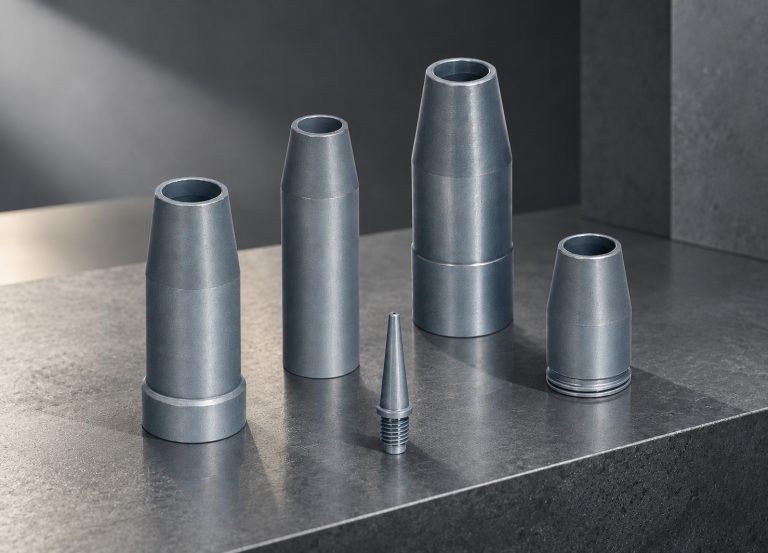
Silicon nitride is highly resistant to rapid temperature changes and is therefore often used under dynamic thermal loads. This property is especially important in cyclic processes and with steep temperature gradients.
Depending on the grade, silicon carbide can have very high thermal conductivity. This allows heat to be conducted or dissipated in a targeted way. In suitable applications, heating and cooling times can be influenced, temperature differences reduced and local overheating avoided.
Electrical properties must also be taken into account. Non-oxide ceramics are not inherently electrically insulating. Depending on the material and grade, they can be insulating, dissipative or conductive. This requirement must therefore be clearly defined at the material selection stage.

In plant engineering, non-oxide ceramics are used for components exposed to high temperatures, particles and continuous operation. They can retain their surfaces and geometry under conditions in which other materials quickly wear or deform.
In chemical and process engineering, abrasive media and high temperatures often come together. Non-oxide ceramics can offer suitable combinations of wear and temperature resistance for this. Chemical resistance must nevertheless be checked separately for each medium and material grade.
In the semiconductor industry, thermal stability, precision and reproducible processes are particularly important. Depending on the application, defined electrical properties are also required. Material, grade and component geometry must be precisely matched here.
Silicon nitride (Si₃N₄) is often chosen when rapid temperature changes and dynamic loads are the main concern. The material has a fracture toughness that is high for a ceramic, making it suitable for components subjected to alternating thermal or mechanical stress.
Silicon carbide (SiC) offers advantages under severe abrasion, at high temperatures and in tasks where heat needs to be conducted in a targeted way. Depending on the grade, SiC is electrically dissipative or conductive and is therefore not automatically suitable for electrical insulation tasks.
Put simply: silicon nitride is particularly suited to thermal shock and dynamic loads, while silicon carbide is best for abrasive and thermally demanding processes. However, the final choice always depends on the complete load case.
For an initial assessment, we need:
We assess whether silicon carbide or silicon nitride is suitable, which grade is an option and which design requirements need to be considered for reliable and economical production.